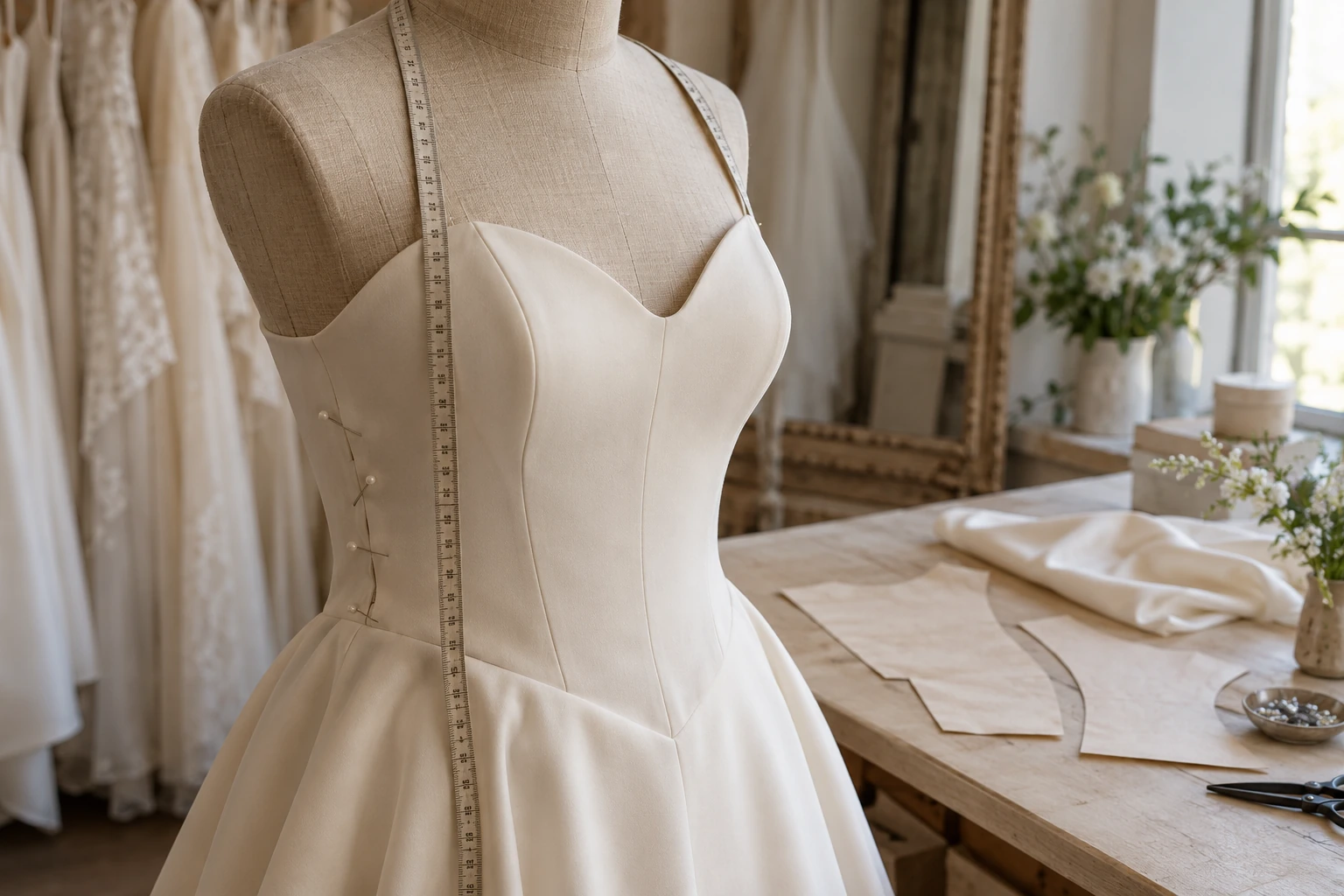
Made to Order and Made to Measure Wedding Dresses Explained for Buyers
Made to order and made to measure answer different questions. Made to order usually describes when a wedding dress is produced: after an order is placed. Made to measure describes how the fit is developed using an individual wearer’s measurements. A gown can be both. For professional buyers, the useful comparison is therefore the production method plus the fit method, rather than choosing between two apparently exclusive labels.
Before ordering, ask the supplier to describe the actual work behind each term. An existing design made in a standard size, an existing design with selected adjustments, and a gown developed for individual proportions can involve different pattern work and different alteration responsibilities.
Separate production timing from the fit method
Use the following distinctions as a framework for supplier discussions. They are purchasing descriptions to confirm, not a universal service standard. A supplier’s own specification and written scope determine what is included.
| Order description | What it can mean | What the buyer should confirm |
|---|---|---|
| Existing design in a standard size | Production starts after order confirmation, using a size from the supplier’s chart. | The chart version, finished length and any permitted options. |
| Existing design with selected size adjustments | Certain body areas, lengths or construction options are changed within a defined system. | Which adjustments are available and which remain standard. |
| Existing design with an individual fit basis | The supplier uses the wearer’s measurements to develop or adjust the fit. | How measurements affect the pattern, what fittings are included and how fit is assessed. |
| New design development | A new style is developed from an agreed design brief. | Whether its first sample and subsequent orders use a standard or individual fit basis. |
New design development is a separate decision from individual sizing. A brand can develop an original style for standard-size production; a boutique can order an existing style with individual fit adjustments. Neither “custom design” nor “private label” automatically tells you how the dress will fit its wearer.
Published bridal policies show why the labels need checking
Danielle Frankel’s FAQ distinguishes made-to-order collection gowns, customization of existing designs, original custom work and made-to-measure services. Its descriptions demonstrate that design changes and sizing changes are separate parts of a bridal offer. They describe that brand’s services, not SOURCEBRIDAL’s policies.
Grace Loves Lace makes another useful distinction: its customized sizing uses size ranges for body areas and is not described as full made-to-measure construction to exact individual dimensions. This is a practical reason to ask how a measurement is used rather than assuming that collecting measurements proves a fully individual fit service.
The same question applies when comparing overseas suppliers. A phrase such as “custom size” is incomplete until the factory explains whether it means choosing a chart size, combining size ranges, changing specific lengths or modifying the pattern for individual proportions.
Match the workflow to the retail promise
For a boutique selling a repeatable collection, standard-size made-to-order production may support a clear customer process when the boutique has checked the sample, size chart and local alteration arrangements. The decision is whether that process supports the fit promise made at the point of sale.
For a customer whose proportions differ substantially from the supplier’s chart, selected adjustments or an individual fit process may be worth discussing. Ask which parts of the gown can actually change. A waist adjustment does not by itself explain how the bodice length, bust position, sleeve or internal support will be handled.
For a brand developing its own collection, first separate style development from customer fulfillment. Decide how the approved style will be ordered later: in a size range, with selected modifications or using individual measurements. This keeps the development brief from silently becoming a promise about every future customer order.
For online retailers, the measurement instructions, product description and alteration advice need to match the supplier’s process. Taking a customer’s measurements to recommend a standard size should not be presented as individual pattern development. These decisions concern the actual service; they do not depend on using a different marketing label in the US, UK or an EU country.
Define what happens after the dress arrives
Do not treat made to measure as a guarantee that no local fitting will be needed. Danielle Frankel notes that alterations may still be required for made-to-measure gowns. Avery Austin also explains that its standard-size gowns may need alterations and discusses the practical limits of seam allowances. These are supplier-specific examples of why fit expectations need explicit discussion.
Before placing an order, establish who checks the fit after delivery, who arranges alterations and how a suspected specification error will be reviewed. Separate an agreed fit preference from a measurable departure from the order. Also ask what alteration allowance is actually present in the relevant seams; do not assume every embellished or structured area can be let out.
The buyer should retain the measurement record and the supplier’s size recommendation. If the wearer changes measurements or footwear later, record the change and request written confirmation of any effect on the order. Avoid promising that a change can be accommodated before the supplier has checked it.
Write a short order description that removes ambiguity
Instead of placing an order described only as “MTO custom size,” document the following points. This is a service-definition record; a detailed measuring guide and final production sign-off are separate tasks.
- Design identity: style reference, design version and the exact approved style changes.
- Production basis: an existing stock item, production after order confirmation or a new development project.
- Fit basis: supplier chart size, specified combined size ranges or an individually adjusted fit process.
- Measurement use: which submitted measurements affect construction and which are used only for size selection.
- Fit responsibilities: planned fittings, local alterations and the agreed way to review a discrepancy.
- Change handling: who can authorize a change and how its effect on the confirmed order is recorded.
If an order uses a size code, name the supplier’s chart and its version. A US, UK or EU label alone does not identify the pattern or finished dimensions being ordered. Keep body measurements and finished garment measurements clearly labeled rather than putting them into one unexplained column.
Ask for the service description before making the customer promise
When discussing a project with SOURCEBRIDAL, identify the wedding dress style, intended customer process and fit method you want to explore. Request confirmation of the available order method and its scope before advertising it to your own customers. A useful first decision is not which label sounds more personalized, but which documented process supports the product and fit promise you intend to sell.